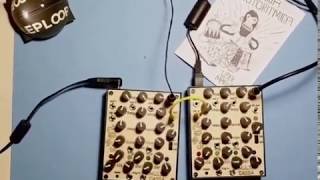
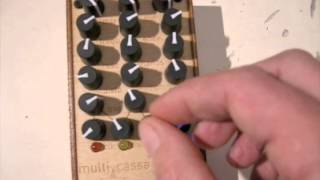
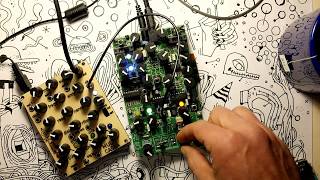
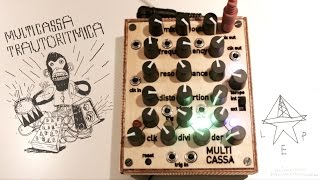
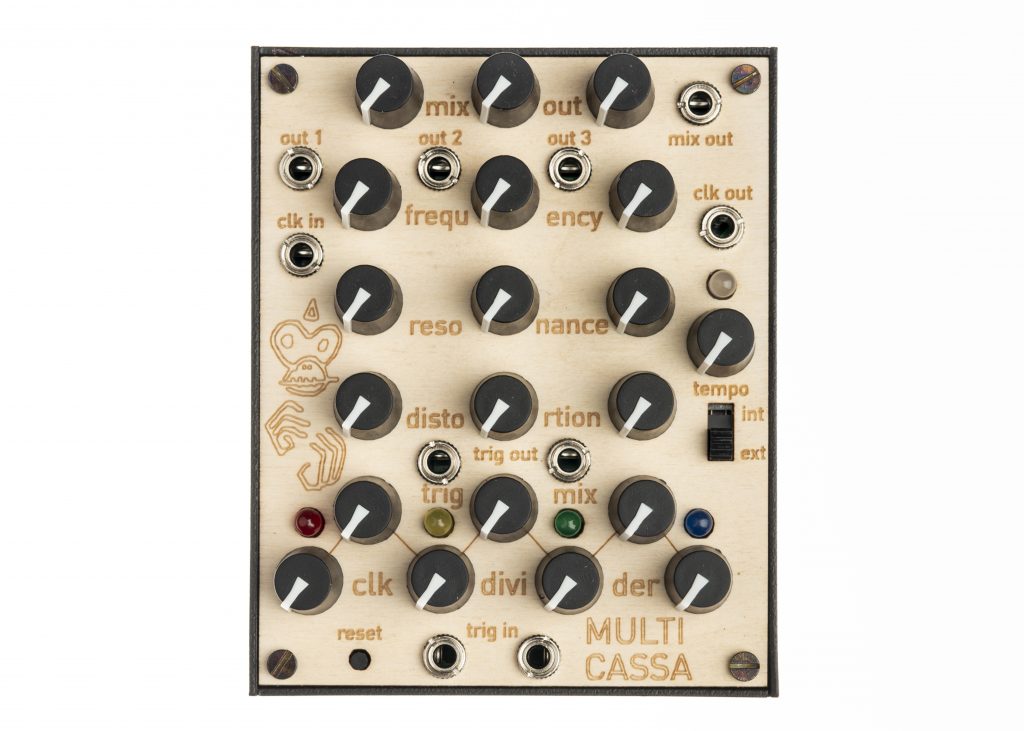
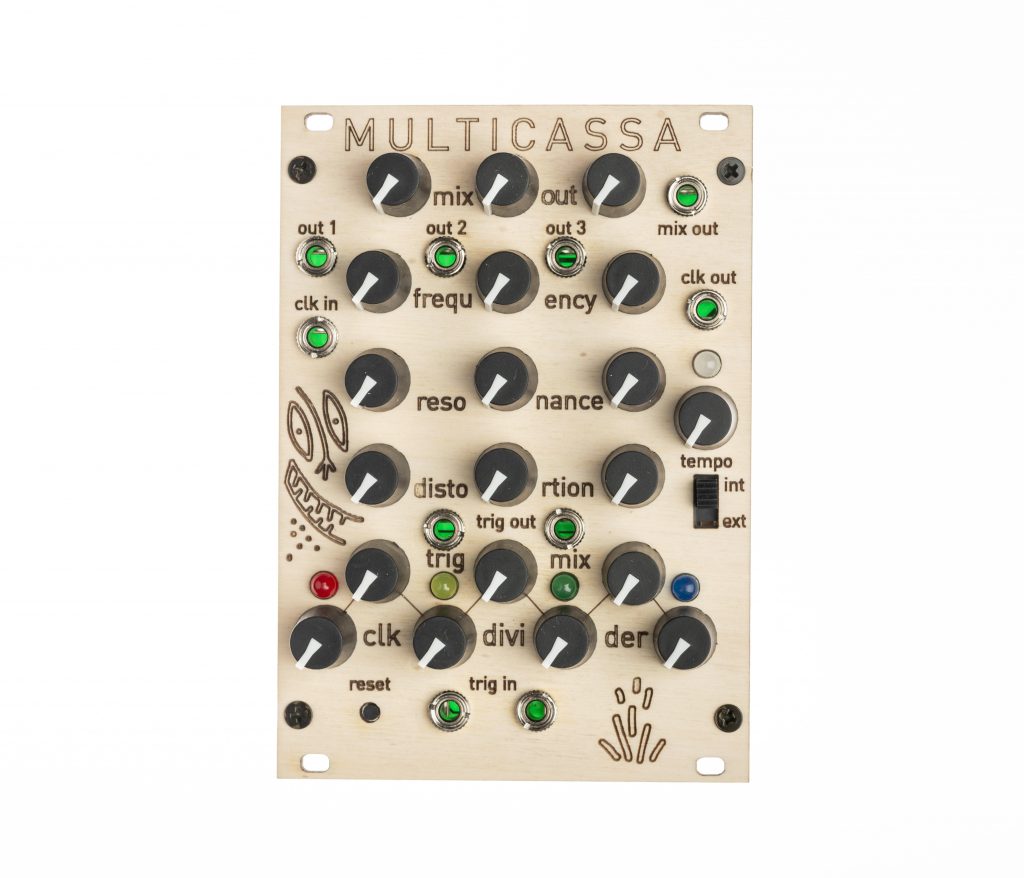
The Multicassa Analog Rhythm Generator is an innovative electronic instrument composed of three distinct analog drum voices controlled by a Trautonium-like rhythmic sequencer. Available in both standalone desktop and Eurorack modular formats, this unique hardware unit allows music producers to sculpt rich polyrhythms. The historical concept behind the device is heavily inspired by the Mixturtrautonium, an early electronic musical instrument invented by Oskar Sala in the 1930s. Pair great with our Arpopone
The term trautonico is inspired by a vintage instrument, the Mixturtrautonium, invented by Oskar Sala, a student of Hindemith. His research elaborated on since the 1930s was based on another, more simple instrument, the Heimtrautonium, manufactured by Telefunken in the 20s. The Heimtrautonium being one of the first electronic instruments for the living room.
Early versions of Mixturtrautonium use as frequency dividers the Thyratron (a type of gas valve that could be used to build oscillators and frequency dividers), these dividers acting on the notes producing subharmonic that could be mixed (hence MIXTUR) for produce complex sounds.
Same principle is used here with two differences:
– The valves are replaced by solid-state trigger circuits.
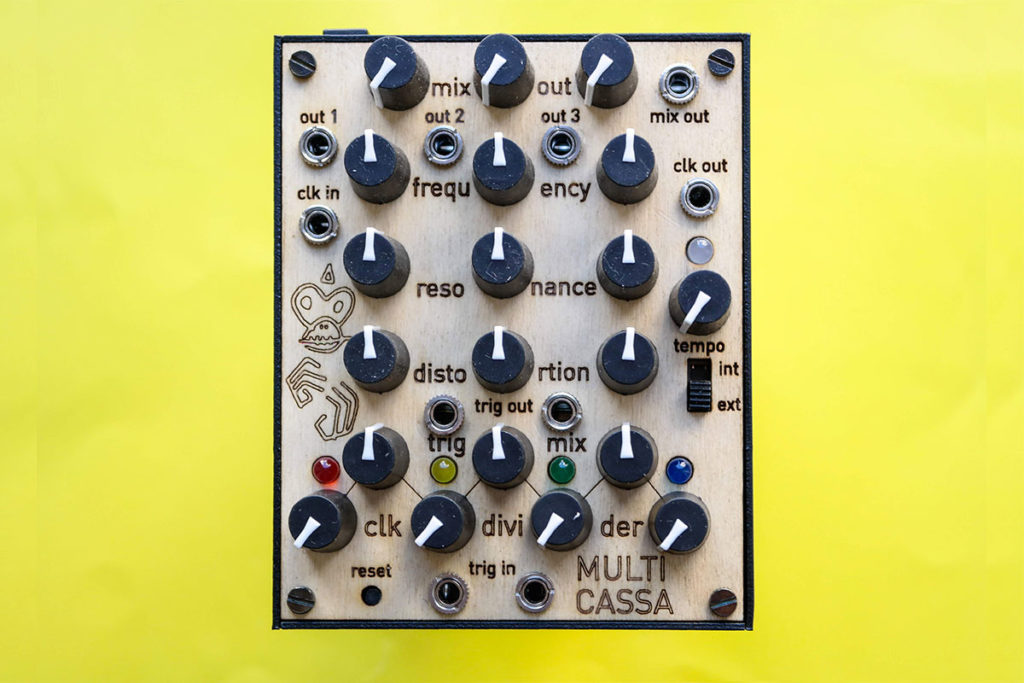
– Dividers act not on the notes but on the rhythms, by dividing a basic rhythm (clock) to a variable number (with the command Clock Divider) rhythms are then mixed 2 by 2 (Trig Mix) generating a complex poly rhythms.
– An output mixer allows you to adjust the volume of each speaker.
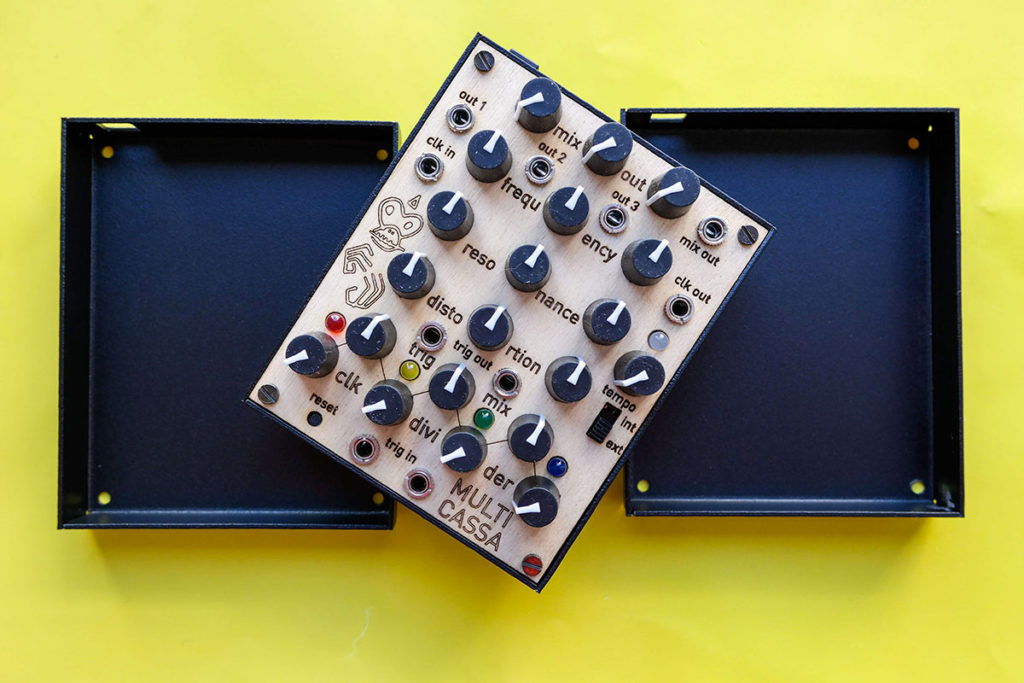
Furthermore, each internal sound generator features independent controls for pitch frequency, resonance, and raw analog distortion. The three separate channels are carefully tuned to cover different acoustic frequency spectrums:
1. Low
(Cassa)
2. Medium
(Bongo\Tom)
3. High
(rim shot\wood block)
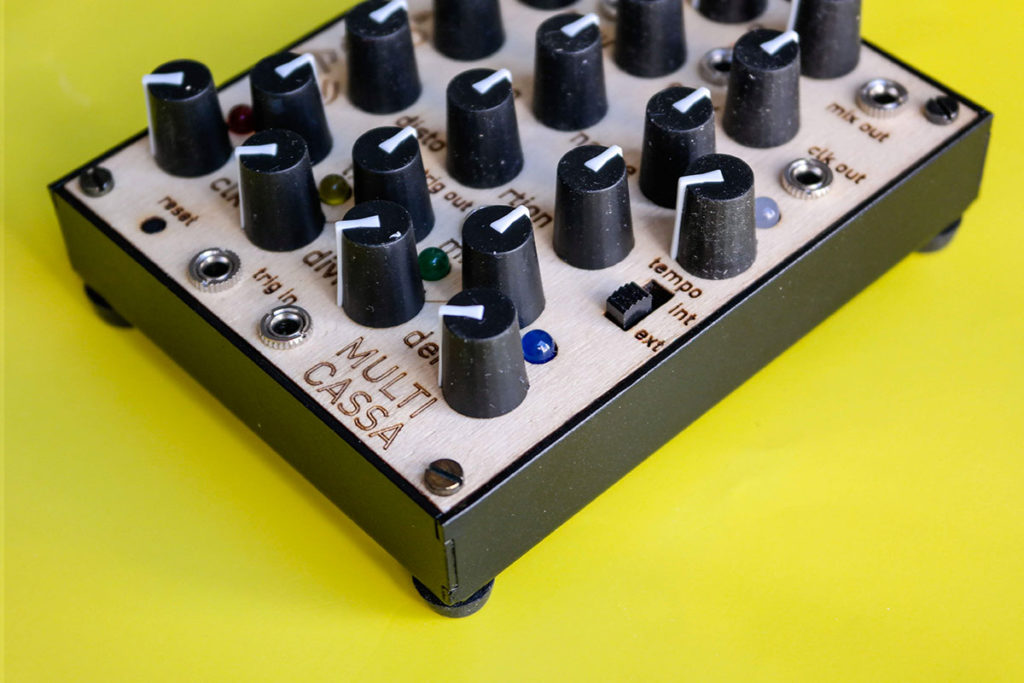
The high channel 3 can produce some scratch noise when you move the frequency pot, because the circuit design and the very high pitch, this is normal. The clock can be generated internally or applied externally through a jack on the left side of the unit.
Technical Features and Power Options
In addition to its internal clock, the unit seamlessly accepts external clock pulses, square waves, and MIDI clock signals. Therefore, you can easily synchronize the module with external sequencers or hardware gear like the Korg Volca series. The integrated audio mixer routes the summed signal to a master Mix Out jack, while independent individual outputs remain available for advanced studio multitrack mixing.
Finally, the power supply input includes a protection diode against reverse polarity. To reduce environmental impact, we highly encourage our users to recycle an old 12V DC power supply from an unused home device. To see how our hardware workflow evolved after this classic release, feel free to read about our updated Multicassa Four Channels edition or explore our full product catalog.
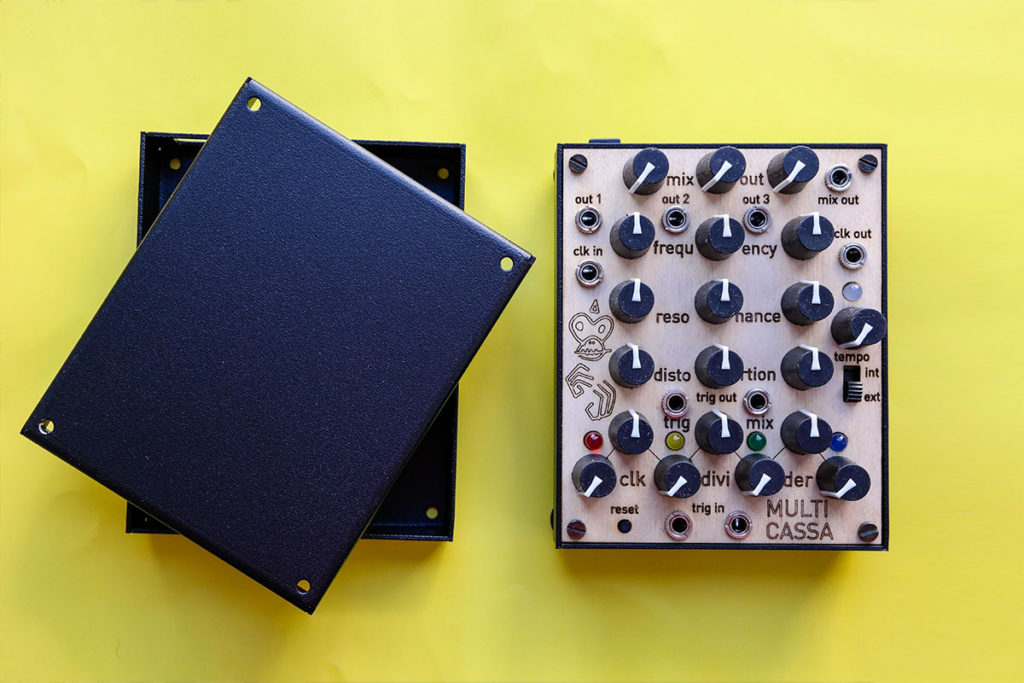
Technical Info
FREQUENCY: Adjusts the pitch of the sound of the case, also affects the resonance
RESONANCE: Adjusts the resonance, i.e. the damping time of the case.
Beyond a certain level, the Cassa go into permanent oscillation.
The level at which the oscillation begins varies with frequency…
DISTORTION: Adjusts the level of signal distortion of Cassa.
TRIG MIX : The rhythm played by each Cassa is the sum of the rhythms generated by the two dividers that are located under the Cassa.
For example, the Cassa 1 plays the rhythms of DIVI1 of trig mix pot. Is all to the left, of DIVI2 if all to the right or a mix in between.
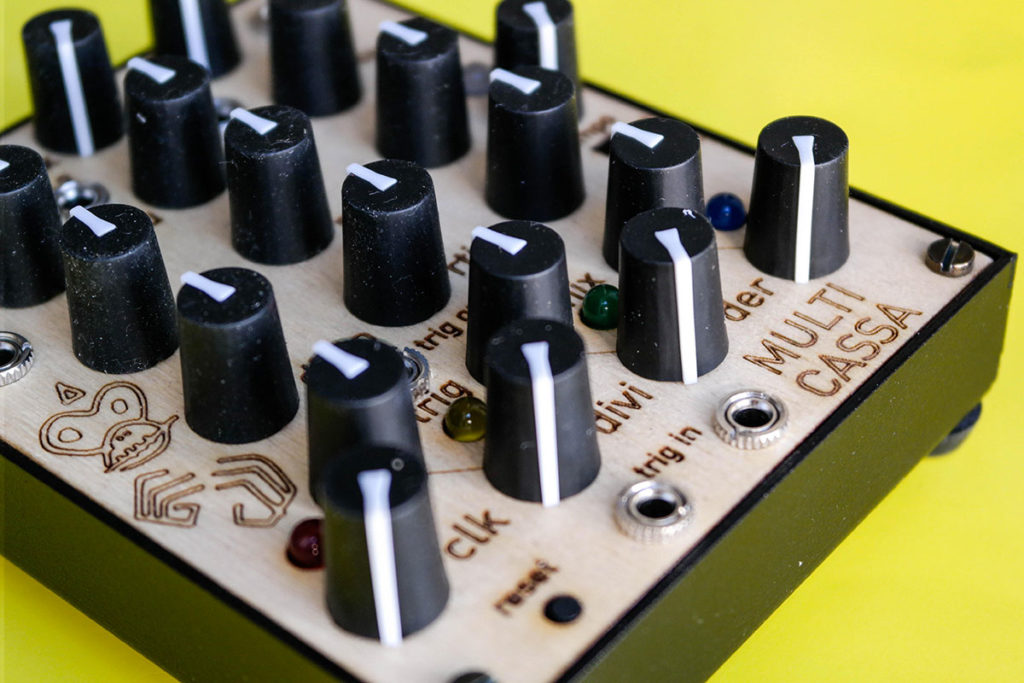
CLOCK DIVIDER : These set the clock divisor, i.e. how many clock pulses (white LED)it takes to get a shot of cash (colored LEDs).
If the potentiometer all the way left, to each pulse of the white LED will have a shot (divisor 1), slowly moving forward we will have dividers more and more high (shots more and more slow).
The max divider is about 64 (potentiometer fully right).
OUT: Multicassa have an internal mixer, the mixed channel is sent to the mix out connector, there is also individual out of the tree channel, when use individual out keep the mix out volume pot to 0.A
TEMPO: In internal clock mode adjusts the speed of the basic clock, and then all of the rhythms. All on the left, minimum speed, maximum speed all right. When you are on the external clock, the tempo pot. Acts as a divider (clock prescaler) in the same way as the clock divider, in this case we will have the maximum speed with the tempo potentiometer all at the left dividing by 1, this is useful for divide fast clock like Midi or Synch 24 for slow clock like Korg volca series keep the divider to 1, tempo pot to 0
TRIG OUT: The trig mix 2 and 3 is sent to trig out connectors,
5 Volt positive trig out.
Power Input: Power also non-stabilized 12 Volts DC 200 Ma with + central tip, tip diameter 2.1 mm (a standard\universal 12V 500 Ma will work anyway).
There is a protection diode for reverse polarity on power in.
Multicassa use an internal 10V voltage regulator, this means power in can be 12V or more like 14v. 18v till 30v max.
The power supply is not included, before you buy a new one, try to recycle a power supply you have at home from an old HD or other device, it’s safe Multicassa did not burn, try to save the planet 😉